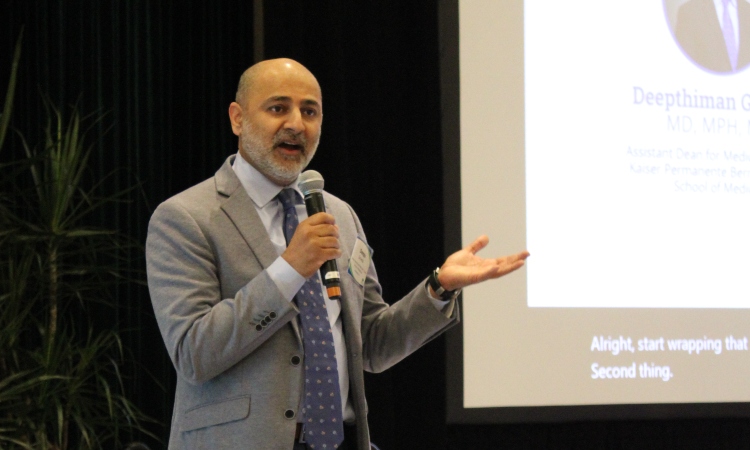
Kaiser Permanente Bernard J. Tyson School of Medicine (KPSOM) Professor Michael Kanter, MD, recently presented an online lecture to doctors in Tokyo as part of an initiative designed to cultivate highly skilled general physicians capable of managing Japan's rapidly aging population and its complex healthcare needs.
The lecture, which was viewed remotely by physicians at Tokyo Metropolitan Matsuzawa Hospital, focused on how healthcare systems can prevent diagnostic delays and missed follow-up through systematic electronic surveillance. Dr. Kanter, who served as KPSOM’s inaugural Chair of Clinical Science from 2020 to 2024 and is now a professor of Clinical Science and Health Systems Science, is internationally recognized as a leading authority in healthcare quality and diagnostic safety and is widely known for leading the development of SureNet, a safety-net system that uses electronic medical records to detect and flag missed follow-up.
“Too often, the responsibility for follow-up relies entirely on the diligence of individual clinicians without recognizing the numerous ways in which follow-up may not occur,” said Dr. Kanter. “What SureNet demonstrates is that when systems are designed thoughtfully to provide a back-up system, we can better ensure that patients do not fall through the cracks.”
Dr. Kanter presented SureNet as a practical safety-net program that identifies patients with abnormal findings such as abnormal creatinine/eGFR, positive colorectal cancer screening results, rectal bleeding, or lung nodules, then ensures that expected follow-up actions are completed.
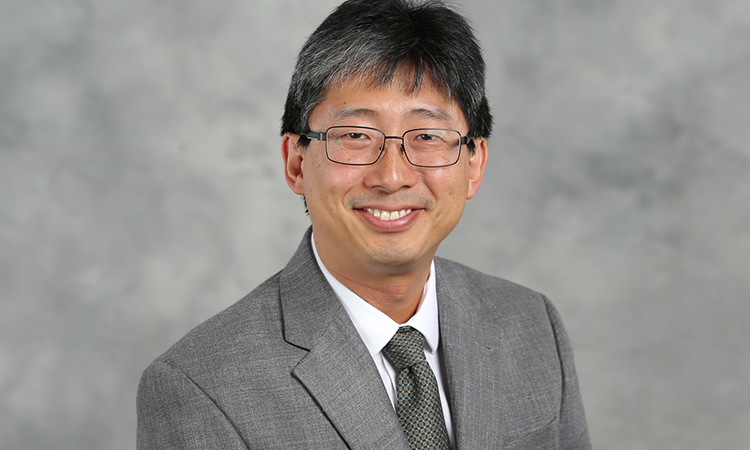
Dr. Kanter’s lecture was presented as part of the Tokyo Generalist Alliance Project (T-GAP), a prominent physician training and development initiative sponsored by the Tokyo Metropolitan Hospitals and Tokyo Metropolitan Health and Hospitals Corporation. For Tokyo Metropolitan Matsuzawa Hospital, the topic also aligned closely with the aims of the hospital’s own Integrated Hospitalist Residency Program, directed by Dr. Megumi Shimada, the hospital’s Vice-Director. The program aims to train generalist physicians who can provide comprehensive medical care for patients with psychiatric disorders. From this perspective, SureNet offered an important model of system-based diagnostic safety that goes beyond individual vigilance.
A central message of the lecture was that diagnostic safety should not depend solely on individual vigilance. Instead, systems must define the problem, select the target test or condition, identify the expected action, use reliable data sources to determine whether follow-up occurred, and intervene when care gaps remain. SureNet is not merely an IT tool, but a clinical quality program built around clear algorithms, leadership support, specialist input, and measurable outcomes.
Dr. Kanter also emphasized several practical and cultural requirements for success. Safety-net programs must use structured data whenever possible, minimize unnecessary burden on physicians, obtain buy-in before implementation, and rely on physician champions. Equally important is a blame-free culture: a diagnostic error persists until the correct diagnosis is made, and clinicians must remain engaged in closing the loop rather than feeling punished by the system.
The lecture also addressed real-world challenges, including false-positive notifications, patient and physician frustration, staff burden, ethical issues around disclosure, and the cost of building such programs. Dr. Kanter’s advice was pragmatic and encouraging: be humble, seek help, do not expect perfection, and start with what is easiest. New programs can be added step by step.