KPSOM Launches Global Health Rotation in Nepal

New effort joins partnership in Kenya and emerging opportunities in Mexico in school’s growing international strategy

July 13, 2026

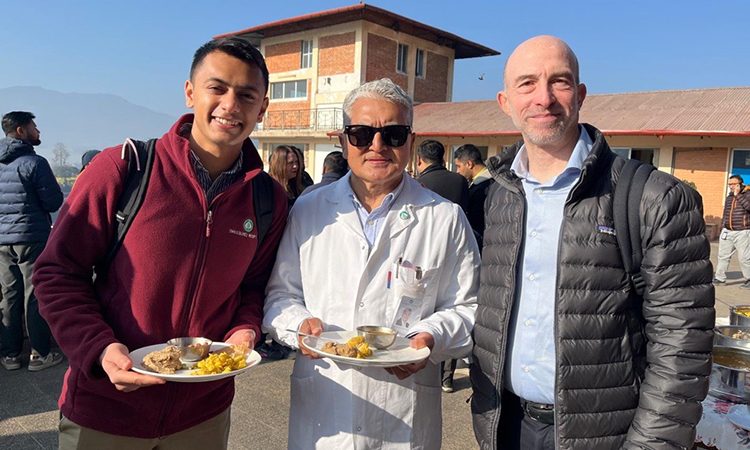
KPSOM Class of 2026 member Barune Thapa, MD (left) with Dr. Ram Kantha Makaju Shrestha, Executive Director of Dhulikhel Hospital (center) and Jeffrey Brettler, MD, KPSOM Faculty Director of Global Health (right).

KPSOM Class of 2026 member Barune Thapa, MD, (left) with Dr. Ram Kantha Makaju Shrestha, Executive Director of Dhulikhel Hospital (center), and Jeffrey Brettler, MD, KPSOM Faculty Director of Global Health (right).

Kaiser Permanente Bernard J. Tyson School of Medicine (KPSOM) concluded its first Global Health student rotation in Nepal earlier this year, marking a major milestone in the school’s growing global health curriculum and partnerships.

Through the AMPATH (Academic Model Providing Access to Healthcare) consortium, KPSOM has established a four‑week rotation at Dhulikhel Hospital, a community‑based health system that includes a tertiary care referral hospital and 18 outreach centers serving roughly 2.5 million people across about two‑thirds of Nepal. The site offers students both inpatient experience at the main hospital and time at rural outreach centers such as Dolakha, where they see firsthand how geography, poverty, and infrastructure shape access to care.

“I definitely intend on being a global health physician,” said student Barune Thapa. “I think that this rotation's been super important for me because I am, for the first time, seeing how clinical care can be delivered really well in rural Nepal and in places where, traditionally, healthcare has not been able to be delivered at this level. I really want to be a part of learning what structural barriers our patients are facing across the globe, and trying to find ways to equitably reduce those disparities. And so, it's a lifelong thing.”

The inaugural rotation, held in January, brought Thapa and fellow student Zeus Islas (both members of the Class of 2026, who have since graduated with the Doctor of Medicine degree) to Dhulikhel Hospital alongside faculty members Jeffrey Brettler, MD, Faculty Director of Global Health, and obstetrician‑gynecologist Sree Chanchani, MD, Clinical Associate Professor of Clinical Science. The students spent their days moving between ward rounds, conferences, outpatient clinics, and specialty areas such as cardiology and the catheterization lab, reflecting a model in which physicians care for patients across settings rather than in narrow roles. 

The faculty paired their clinical work with teaching, with Dr. Chanchani delivering seven lectures, leading a shoulder dystocia simulation, and visiting rural clinics, while Dr. Brettler engaged local leaders in population‑health and systems‑of‑care discussions.

For Islas, who previously volunteered with the Refugee Health Alliance in Tijuana, the rotation was “extremely eye‑opening” in showing how clinicians provide high‑quality, patient‑centered care with far fewer diagnostic and therapeutic resources than in the United States. He recalls surgical cases in which patients presented with such advanced kidney disease that “complete nephrectomies” were required, and a man who lived for 18 years with a metal tracheostomy tube that had broken before he sought care, illustrating how long travel times and difficult terrain delay treatment. 

“Seeing these physicians work in these resource‑limited settings and yet still putting patient‑centered care at the center was extremely insightful and really helpful overall,” Islas said.
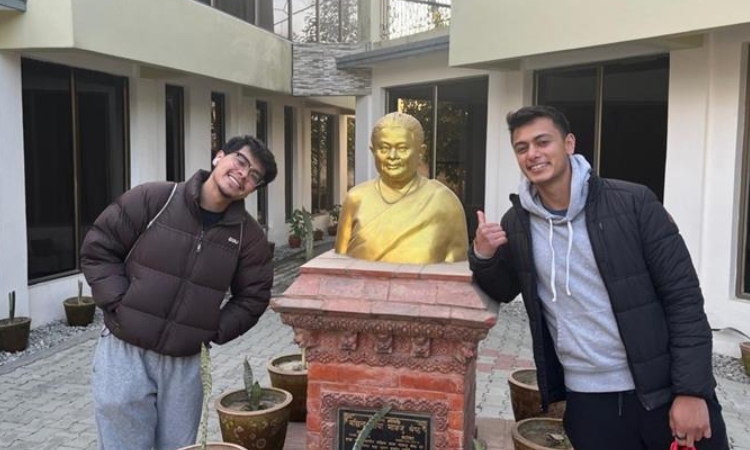
Zeus Islas and Barune Thapa in Nepal.

Zeus Islas and Barune Thapa in Nepal.

Thapa’s family is from Nepal, and his personal connection to Dhulikhel Hospital stretches back to high school, when he first volunteered there shortly after his father’s death and began to understand how structural forces like poverty, gender roles, and air pollution determine health, he said. Over the years he founded an undergraduate GlobeMed chapter to support community programs at the hospital, conducted research on the intersection of COVID‑19 and poverty, and spent a year in Nepal before returning there this year as a KPSOM medical student. 

“I’ve done volunteer work and research here over the years, and now I’m here with [KPSOMl, which has been amazing,” Thapa said. “Because now I'm actually getting to be a part of the clinical aspect as well, and learning about that.”

KPSOM’s global health strategy follows AMPATH’s tripartite mission of education and training, clinical care, and research, with an emphasis on long‑term partnerships and bidirectional exchange. While this first rotation sent KPSOM students and faculty to Nepal, the Office of Global Health is already working to host Nepali trainees in the United States in the near future, mirroring an existing exchange with the school’s Kenya site. 

“Every time we send students, the expectation and our hope as well is that we host trainees,” Dr. Brettler noted, stressing that the program is designed to move beyond short‑term “voluntourism” toward sustained collaboration.

Preparation for the rotation included orientation on Nepal’s health system, medical education, and global burden of disease, as well as mock clinical sessions that emphasize a collaborative mindset and resource stewardship. Building on Swahili lessons that precede the Kenya rotation, the Office of Global Health is now developing Nepali language and culture sessions to improve communication and cultural humility for future cohorts. Islas said the most challenging aspect of his time in Nepal was the language barrier with patients who did not speak English, but he used translation tools and sought help from colleagues. He said, “Even though I wasn’t able to speak Nepali, we were still able to connect.”

The Nepal rotation joins KPSOM’s established fourth‑year global health rotation in Kenya and more recent opportunities in Tijuana, Mexico where students and faculty partner with the Refugee Health Alliance, providing care in a clinic and in shelters that serve refugees and asylum seekers.

All KPSOM first‑year students receive an introduction to global health, and the Office of Global Health is developing a third‑year refugee health elective in partnership with the Los Angeles County Department of Public Health and local resettlement agencies, anticipated for early 2027. A large Global Health Interest Group collaborates with faculty on local “global‑local” activities such as health fairs and workshops serving immigrant and refugee communities, extending these lessons into the neighborhoods surrounding the school. Interest is high, Dr. Brettler said, reflecting students’ desire to engage with issues of health equity, culture, and structural determinants of health.