KPSOM Spotlight

Doctor’s Notes: The KPSOM Student Orchestra Resounds

The ensemble gives future physicians space to play, listen, and find restoration through music

July 09, 2026

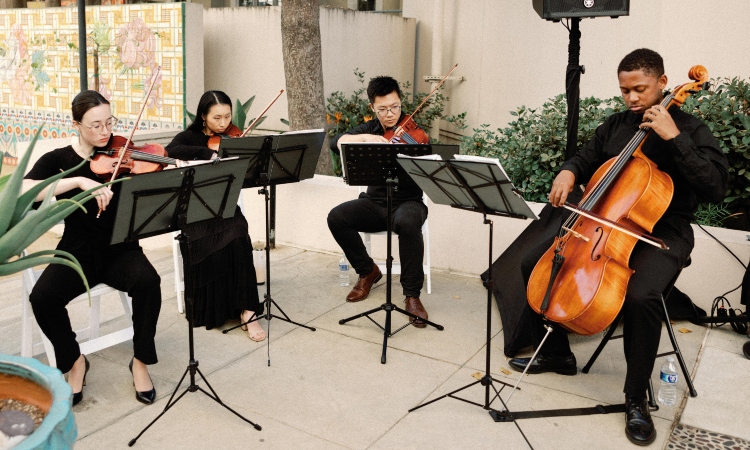
Members of the KPSOM Student Orchestra performing at the wedding of Vicky Quach, KPSOM Business Consultant in the Office of Faculty Affairs.

Members of the KPSOM Student Orchestra performing at the wedding of Vicky Quach, KPSOM Business Consultant in the Office of Faculty Affairs.

What began as a small group of classmates trying to reconnect with their instruments has grown into a flexible, student-led ensemble and club that now counts more than 20 members and a steady calendar of performances. 

The KPSOM Student Orchestra has quickly become one of Kaiser Permanente Bernard J. Tyson School of Medicine’s (KPSOM) most distinctive traditions, giving musically trained students a way to sustain their artistry while supporting the school at events ranging from commencement to memorials and even a staff wedding.

“There are so many musicians that go into medicine, and we felt like it was really important that we find a way to preserve that, especially because it is so helpful in the medical field to have those musical thought processes and expression,” said Kathryn Schwarzmann, MD, a member of the KPSOM Class of 2026 and a founding member of the orchestra. “We wanted to create a space where people could be encouraged to keep playing music, where people could be encouraged to share the joy of listening to music and talking about music. We wanted to keep it very open, so that even non-musicians could join; the only requirement is a love of music.”

The orchestra’s origins trace back to 2023, when Kathryn and a few classmates began talking about how much they missed serious music-making. Kathryn, who holds a degree in violin performance from Northwestern University and once served as Director of Education and Community Engagement for the Madison Symphony Orchestra, had been pursuing a professional musical career before pivoting to medicine and psychiatry. She remained convinced that her music background was relevant to clinical work, especially psychiatry’s focus on emotion and narrative.

Around the same time, Kathryn’s scholarly project with faculty member Deepthiman “Deepu” Gowda, MD, MPH, MS, Assistant Dean for Medical Education, focused on music and medicine within the school’s REACH curriculum, became an unlikely incubator for a new student ensemble. To bring that session to life, she recruited fellow students Felice Liang (violin), Andrea Yeung (piano and strings), and cellist Shaheed Muhammad (cello) to form a live chamber group that would perform and record a piece used in a narrative medicine session. Weekly rehearsals convinced the group that KPSOM needed a permanent space for students to play, listen to, and talk about music.

The concept came together: an ensemble-centered group that might one day resemble a traditional orchestra. But as they soon discovered, the small size of KPSOM’s classes, and the uneven distribution of instruments, made it more natural to think in terms of flexible small ensembles rather than a true orchestra. Under Andrea’s leadership in subsequent years, the group has evolved into a broader club, now known as the KPSOM Student Orchestra, that welcomes both performers and non-performing music lovers.

The group is formally organized through the school’s Engage platform, where it currently lists about 19 active members and a total club roster of 22 students, with a core of 10 to 15 regularly involved in performances and planning. That combination of structure and flexibility makes it possible for a busy, rotating cast of medical students to plug in when they can, without the pressure of a schedule.

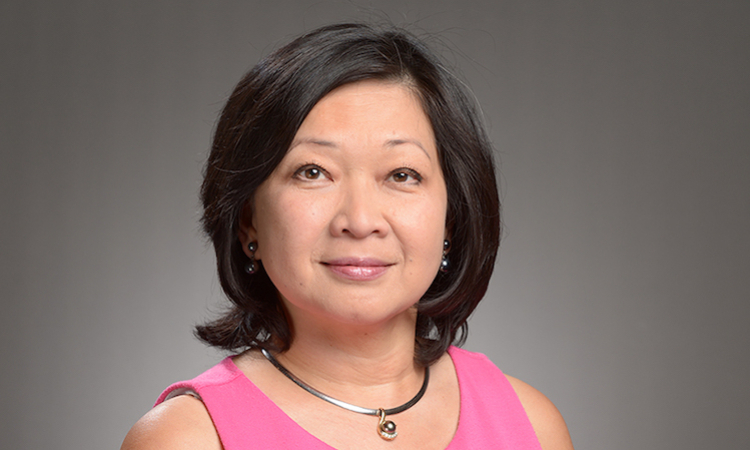
As the group took shape, members turned to Roland Tang, MD, Clinical Assistant Professor of Clinical Science, to serve as faculty adviser. Dr. Tang had a love of music, and he saw the role as a chance to encourage students to keep music in their lives during training and beyond. The students organize their own performances and events, while Dr. Tang focuses on connecting them with opportunities and reminding them that art can be “restorative” during the most demanding years of medical school, he said.
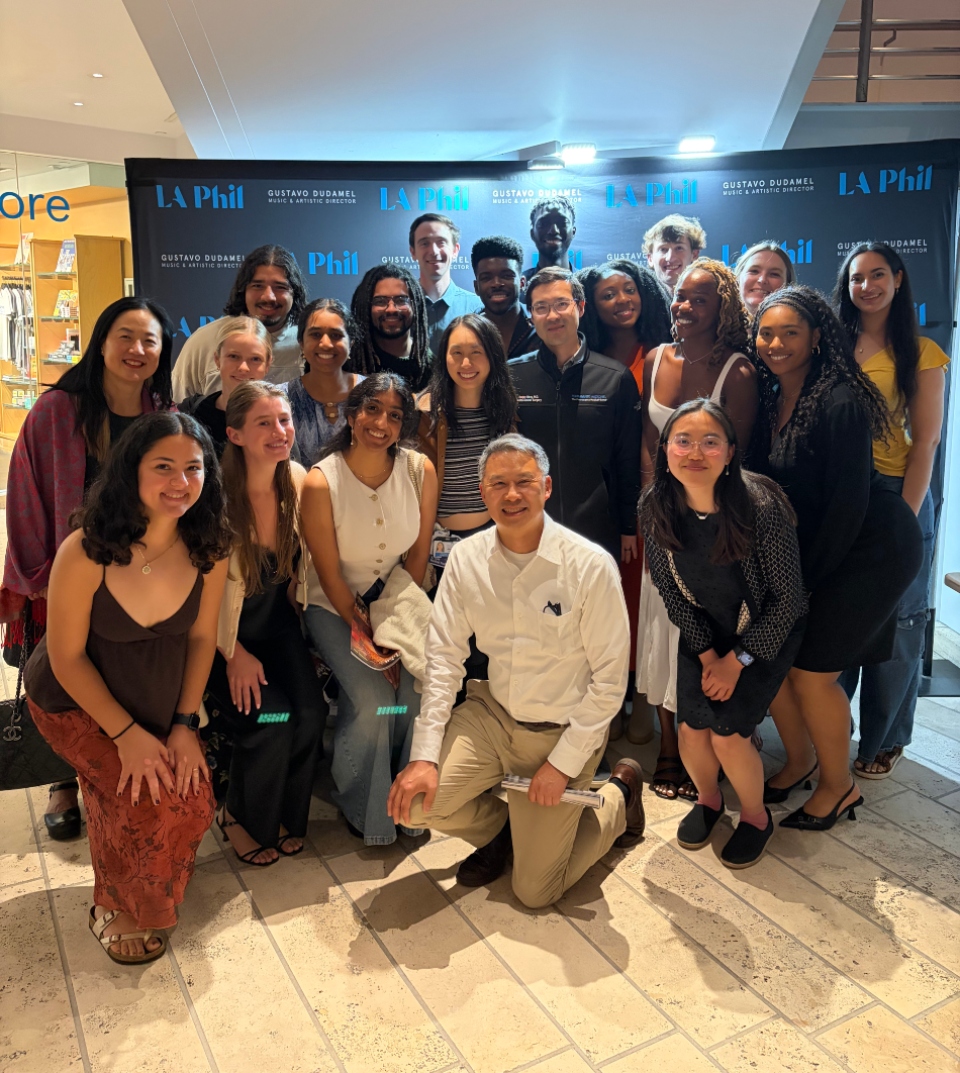
A group outing to a Los Angeles Philharmonic performance of Rachmaninoff’s Second Symphony at Disney Hall in Los Angeles.

A group outing to a Los Angeles Philharmonic performance of Rachmaninoff’s Second Symphony at Disney Hall in Los Angeles.

“This is an incredible part of the school that the students have created for themselves,” said Dr. Tang. “When they are exhausted emotionally, physically, and mentally, music can be such a restorative practice. Music can speak to you in a way that no other language can.” He points to a recent outing in which about 20 students attended a Los Angeles Philharmonic performance of Rachmaninoff’s Second Symphony, preceded by a music appreciation talk by Kaiser Permanente cardiovascular surgeon Hanjay Wong, MD. Afterward, the students and Dr. Wong reflected on what they noticed and felt, mirroring the reflective work of narrative medicine.

KPSOM Student Orchestra members bring varied musical histories, but all share a sense that music is tied to who they are as future physicians. Kathryn Schwarzmann began playing violin at age 10 and immersed herself in classical music, eventually working professionally in music education before pivoting to medicine. Now embarking on a psychiatry residency at Northwestern, she sees a direct throughline from the “creative and musical thought” she honed as a violinist to the empathy and emotional attunement required for psychiatric interviews.

Felice Liang, a classically trained violinist who grew up immersed in music from early childhood, thought her classical music performance career had peaked in college, where she played in symphony and chamber orchestras before the pandemic forced community ensembles to disband. Working as a research assistant during the COVID years, she drifted away from regular playing and did not fully reconnect with her instrument until starting medical school and meeting Kathryn. Through conversations in their REACH group, Felice and Kathryn realized they shared a complicated relationship with classical music’s perfectionist culture and the “stigmas” around calling oneself a musician while no longer on a professional track. Reclaiming their musician identities meant giving themselves permission to be “hobby musicians” who could still play complex repertoire imperfectly, and joyfully, alongside demanding medical training, Felice said.

For Andrea Yeung, who started piano at six and violin at seven, music has always meant both solo and ensemble life: taking up “so much space” at the piano while also loving the way orchestral parts interlock. She grew up in public-school orchestras, eventually auditioning into an advanced high school chamber ensemble, but set violin aside in college and did not own an instrument when she first heard about musical opportunities at KPSOM. That changed when Kathryn and Felice began recruiting string players for the REACH music-and-medicine project; Andrea rented a violin and even briefly switched to viola to help fill out the parts. Weekly rehearsals forged “good synergy” among the players, and Andrea quickly realized how much community the project was bringing into her life. She joined orchestra leadership soon afterward, driven by a vision of an end-of-year showcase where students could share their talents with peers who normally saw them only in lecture halls and clinics.

The resulting recital, held in May 2025 on the school’s convening stairs, featured a 90-minute program of solos and ensembles, from original singer-songwriter sets to electric guitar performances and classical chamber pieces. Andrea recalls a packed space where students sang along and “the energy in the room was so great,” describing the experience as “almost spiritual.”

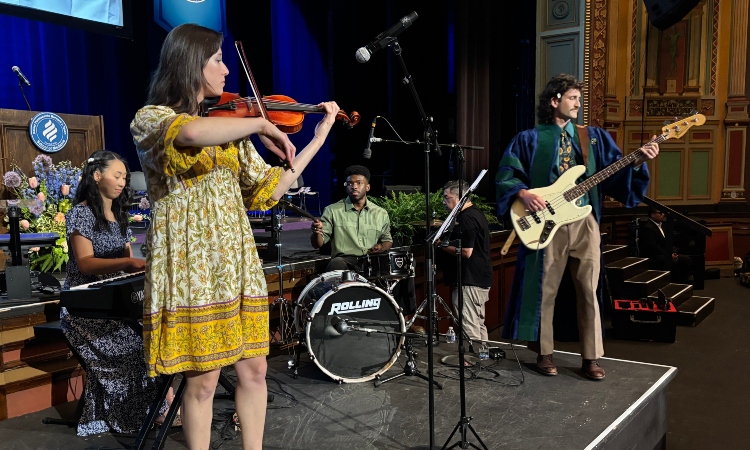
If some orchestra members came up through youth orchestras, KPSOM student Gospel Ibe arrived through a more contemporary route. Gospel started on drums in early childhood, added piano around age eight and guitar at ten, and spent much of college casually playing in campus music rooms. When he arrived at KPSOM, the smaller scale of the school made it feel easier to get involved in the orchestra. His versatility has made him a go-to collaborator when the group shifts toward band configurations, such as a recent performance at the 2026 commencement ceremony, when they played an instrumental set of pop and soft rock tunes by artists ranging from Bobby Darin to Bill Withers to Arctic Monkeys using a lineup of drums, bass guitar, piano, and violin.

Members of the KPSOM Student Orchestra performing at the 2026 Commencement Celebration.

Members of the KPSOM Student Orchestra performing at the 2026 Commencement Celebration.

In just a few years, the KPSOM Student Orchestra has built an impressive portfolio of performances that mark important milestones for the school. Off campus, one of its most memorable performances took place at the wedding of KPSOM Business Consultant Vicky Quach, where a student quartet played an arranged set. Another defining moment came at the memorial service for physician leader Dr. Holly Humphrey, former Chair of the KPSOM Board of Directors, where Andrea and Felice performed “Meditation” from the opera “Thaïs" by French composer Jules Massenet, a favorite piece of Dr. Humphrey’s.

“In medical school, everyone’s trying to find community through different hobbies and interests,” said Andrea Yeung. “This is a very special one because people are very connected to their instruments in a way they might not be for other hobbies or interests; it feels very much a part of themselves, a piece of their identity. When someone finds another person who they can really jam well with or play music with, they feel very understood and seen. And I think that’s why people really love coming back to this orchestra community, because you’re creating something that’s bigger than yourself. It’s very enriching.”