Events

White Coat Ceremony Introduces KPSOM Class of 2030

New students mark beginning of their medical school journey at traditional event

August 18, 2026

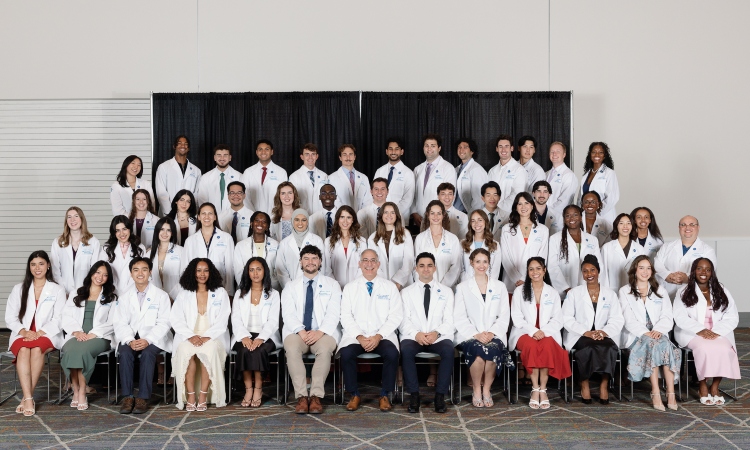
Members of the Class of 2030 at the KPSOM White Coat Ceremony.

Members of the Class of 2030 at the KPSOM White Coat Ceremony.

As their families and friends looked on with pride, the 50 members of Kaiser Permanente Bernard J. Tyson School of Medicine’s (KPSOM) new Class of 2030 received their traditional white coats in a ceremony at the Pasadena Convention Center on Friday, August 14.

Parents, school leaders, faculty, and staff were in attendance to see each student cross the stage as their designated faculty physician placed a short white coat on their shoulders. The event marked KPSOM’s seventh White Coat Ceremony since the school first opened its doors in 2020.

“The importance of the white coat has never really been about the coat,” KPSOM Dean and CEO John L. Dalrymple, MD, said in his keynote address. “It has always been about what it symbolizes. Which brings me to the one idea I hope you remember from today. The coat does not make the person; the person makes the coat. The compassion does not come from the coat; the integrity does not come from the coat. Neither does the commitment to patients, or all the expertise you will absorb and make your own while wearing it. Those things come from you.”

The Class of 2030 students officially began medical school several weeks earlier, and they have already been exposed to small-group learning sessions in the classroom and have visited the Kaiser Permanente medical facilities where they will experience their clerkships. Many commented on the friendships and bonds they have begun forging amongst themselves in just a short time working together.
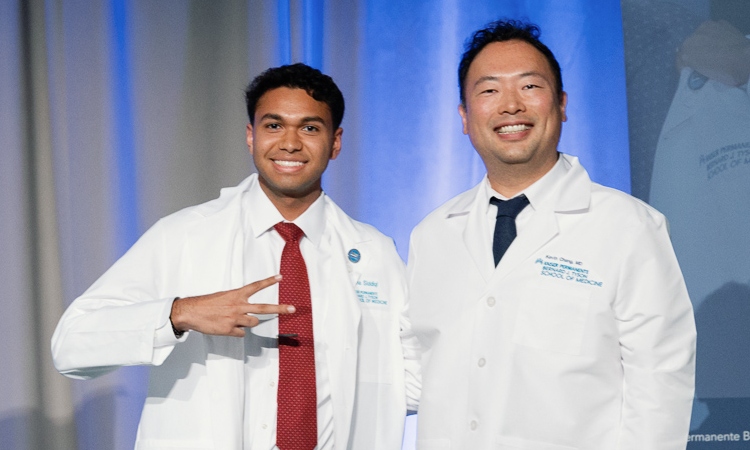
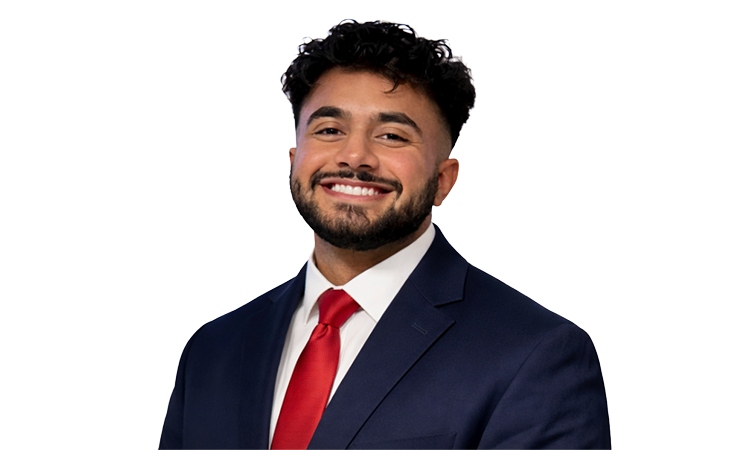
Student Talha Siddiqi and Kevin Chang, MD, Clinical Assistant Professor of Clinical Science, onstage at the ceremony.

Student Talha Siddiqi and Kevin Chang, MD, Clinical Assistant Professor of Clinical Science, onstage at the ceremony.

“I'm noticing a great cohesion, great sense of camaraderie between us,” said student Javier De la Peña. “We've only known each other, like, three weeks, 21 days. But I know that I've developed lifelong friendships here. It feels like a really nice group to share these next four years with. We come from different backgrounds, different cultures, and different everything, but it does unite us, that sense of purpose that we have towards [serving the medical profession] and becoming the best physicians that we can be for our patients.”

The students actually had worn their white coats for the first time, albeit briefly, when their class photos were taken at a welcoming event in late July, just before the start of the school year. For many, the donning of the coat carried significance beyond merely the symbolic start of a new career.

“When I put this white coat on for the first time, I felt a very large responsibility,” said Elizabeth Trinh. “I'm really only here because of the sacrifices of my entire family. And I owe it all to them, and I owe it to my community. So, I just feel very grateful, very fortunate. I wouldn't be here without my loved ones and a large responsibility to give back with what this will provide me with.”

“It was very surreal getting the coat because it represents so much,” said Hillary Yoseph. “Just how much my family has sacrificed for me to be here, what it represents in the world, and how it's now going to be part of my identity. So, I'm very humbled to wear the coat.”

Brandon Moghanian added: “I had worked with many patients before I started medical school, especially those who are unhoused and suffering from substance use disorders. Helping that population was really my motivation for coming to medical school. And having the white coat on me and actually feeling it on my body, it was like a milestone that I didn't know was there, but when I felt it, I'm like, ‘Wow, I'm actually here.’”

The modern White Coat Ceremony originated in 1993 at Columbia University’s College of Physicians and Surgeons, where pediatric neurologist Dr. Arnold P. Gold and the Arnold P. Gold Foundation created it to introduce students to medicine’s ethical and human obligations at the beginning of training rather than waiting until graduation for an oath, and welcomes them as apprentice members of the profession. It has become a rite of passage that symbolizes a commitment to compassionate, patient-centered care, ethical responsibility, humility, and the trust that physicians must earn from patients, ideals that were on the minds of many students at the ceremony.

“Wearing this coat means that society and people are putting their trust in you to take care of them, to be empathetic and to be healers,” said Niyat Efrem. “And they're trusting you with the one thing that is most valuable in life, which is their health, their family's health, their children's health.”

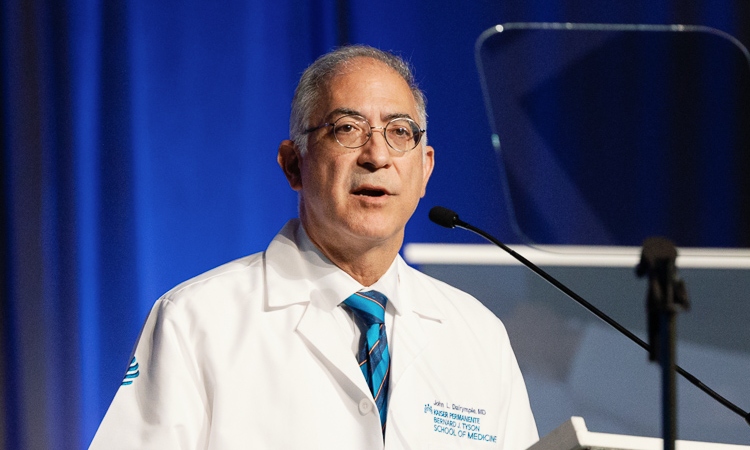
KPSOM Dean and CEO John L. Dalrymple, MD, delivers keynote remarks.

KPSOM Dean and CEO John L. Dalrymple, MD, delivers keynote remarks.

“Initially, when I put the coat on, it felt kind of gimmicky, but it started afterwards to kind of sink in,” said Johnathan Forde. “I have been given this opportunity, this responsibility, and this is the shell that shows the outside world who I am and what I do.”

In presiding over the White Coat Ceremony for the third time as Dean of KPSOM, Dalrymple praised the Class of 2030 for their “energy and enthusiasm.” The ceremony, he added, offers a moment to reflect on what the white coat represents to experienced physicians and what it promises for those just starting medical school.

“It takes you back to when you first donned the white coat,” Dalrymple said. “And it reminds you of a lot of the insecurities and uncertainties, sort of the awkwardness and the discomfort of wearing the coat at first. I smile when I think about how quickly the students are going to evolve into their own comfort, their own identity and development as doctors. To think that in four years they're going to be graduating and becoming interns, and you realize how much they're going to learn in those four years. And certainly, the white coat is going to take shape and evolve with them as they grow.”

During the ceremony, Mohamed “Moe” Aboufares, MBA, CPA, Senior Associate Dean and Chief Financial and Operations Officer, presented the students with the class of 2030 pin on behalf of Greg Adams, Chair and CEO of Kaiser Foundation Health Plan and Hospitals. Jonathan Finkelstein, MD, MPH, Senior Associate Dean for Research and Scholarship, introduced faculty members, clerkship directors, and site directors, who presented students with their white coats.

The Physician's Oath was introduced by Lindia Willies-Jacobo, MD, Senior Associate Dean for Admissions and the Senior Associate Dean for Inclusive Excellence, and it was read by H. Carrie Chen, MD, PhD, Associate Dean for Medical Education Research and Scholarship, Paul Chung, MD, MS, Chair of Health Systems Science, and Deepu Gowda, MD, MPH, MS, Assistant Dean for Medical Education.

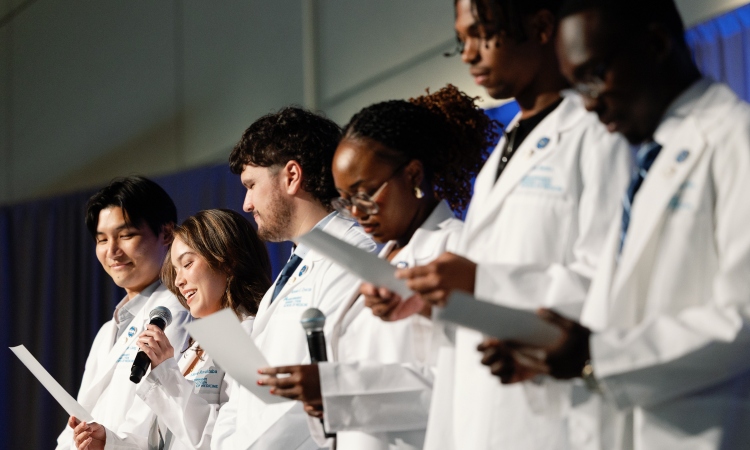
Members of the Class of 2030 read the Community Agreement.

Members of the Class of 2030 read the Community Agreement.

The Class of 2030 Community Agreement was introduced by Lori Carter-Edwards, PhD, MPH, Senior Associate Dean for Community Engagement and Government Affairs, and it was read by the student editors who oversaw it: Baffour Adusei-Poku, Ashlie-Chellsie Aminkeng, Rufus Banks, Alexander Liang, Nicholas Oyarzun, and Liliana Ruvalcaba.

Having family and friends accompany them on stage to accept the white coat made the ceremony even more meaningful, many students said. 

“It means everything,” said Efrem. “My parents are Eritrean immigrants. They sacrificed everything for me and my brother. So, to have them here today meant the world to me. It was a highly emotional day, but it was great.”