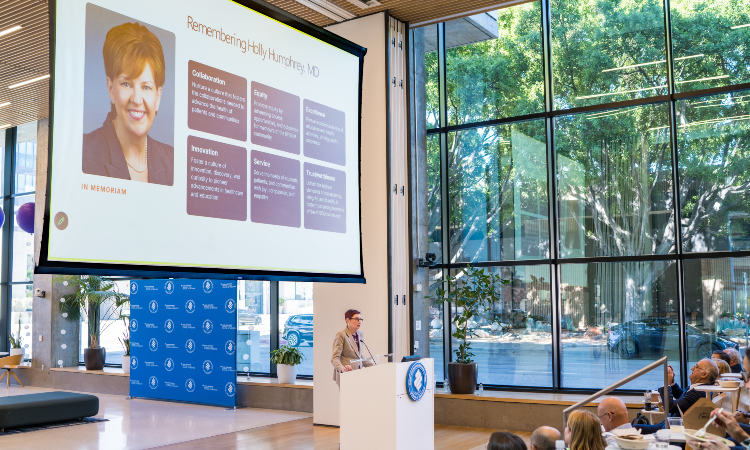
Kaiser Permanente Bernard J. Tyson School of Medicine (KPSOM) honored the life and influence of Holly J. Humphrey, MD, with the inaugural Holly J. Humphrey Distinguished Lectureship in Medical Education on October 28, establishing a new annual tradition dedicated to advancing ideas about the future of medical education. Dr. Humphrey, who served on KPSOM’s Board of Directors for nearly a decade, including several years as chair, was a nationally renowned medical educator and leader who helped shape the school during its formative years.
“Holly would have been very proud,” said Humphrey’s spouse, Duane Follman, MD. “She put her heart and soul into this school. She loved the medical students. She loved medical education. She wanted to make sure those who didn’t have an extra chance in life would have an opportunity. She grew up in very simple circumstances, and she never forgot her roots. She implemented that here, and she would have been so happy to see what has become of [KPSOM].”
To launch the lectureship, KPSOM welcomed Catherine Lucey, MD, MACP, executive vice chancellor and provost at the University of California, San Francisco and one of the nation’s leading voices in medical education. In her keynote, “How Medical Education Can Aim Higher on Behalf of Our Patients and Our Learners,” Dr. Lucey challenged educators to consider how medical education must evolve to better serve both. Her participation as the inaugural distinguished lecturer underscored the significance of the new KPSOM tradition and was particularly fitting given Dr. Humphrey’s lifelong commitment to learners, educational excellence, and meaningful change in medicine.
“This lectureship is particularly meaningful to our school because Holly was a part of KPSOM from the very beginning,” said KPSOM Dean and CEO John L. Dalrymple, MD, reflecting on Dr. Humphrey’s influence on the school she helped establish. “She helped shape our school in many important decisions that brought us to where we are today.”
Dr. Humphrey was also, Dr. Dalrymple noted, a beloved educator deeply committed to preparing and mentoring future generations of physicians. “It feels especially fitting to honor her by creating a tradition devoted not only to excellence in medical education, but also to the exchange of ideas about where it goes next,” he added.
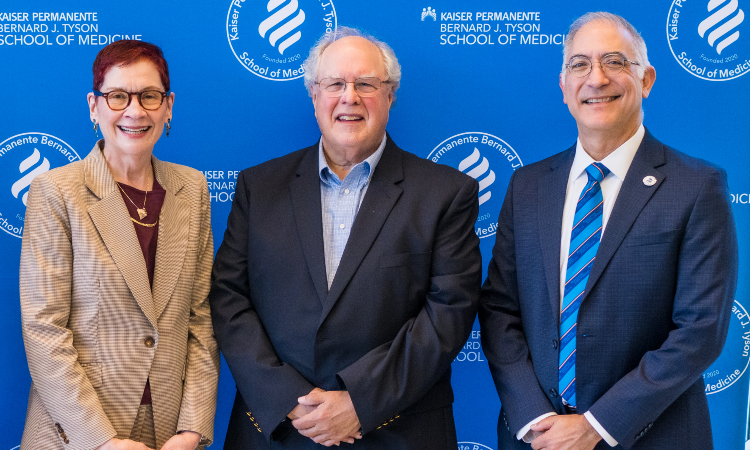
The event brought together KPSOM faculty, staff, students, board members, leaders, and supporters. Among the special guests were Dr. Humphrey’s spouse, Duane Follman, and Kimberly Lomis, MD, FACS, president of the Josiah Macy Jr. Foundation.
Peter Goodwin, MBA, chief operating officer and treasurer of the Josiah Macy Jr. Foundation, where Dr. Humphrey served as president, reflected on the personal values at the heart of her leadership. “Above all, she was a person of extraordinary integrity, deep humanity and unwavering conviction,” Goodwin said. “She believed medicine was not simply a profession, but a moral calling, and that educating future physicians carried a profound responsibility to patients, communities and society.”
Goodwin described Dr. Humphrey as a gifted listener and generous mentor who made others feel “seen, valued and capable of more than they had imagined.” Her conviction that medical education could help create a more compassionate, just, and equitable health system closely aligned with KPSOM’s mission and values. “When the Macy Foundation supported this lectureship in Holly’s name, we hoped it would become a continuing expression of those ideals,” Goodwin said, “challenging us to think deeply about the values we pass on and the kind of physicians and learners our communities need.”
For Dr. Lucey, that connection was personal as well as professional. Before becoming Dr. Humphrey’s colleague, she said, she had followed her medical education leadership career as a young program director, learning from how Dr. Humphrey combined institutional and national leadership with an unwavering commitment to her values.
Dr. Humphrey was a “fierce advocate for the well-being of learners,” Dr. Lucey said, and for bringing learner perspectives into decisions that affected their education and their futures as physicians. She also saw Dr. Humphrey’s influence in the values KPSOM chose for itself. “Those clearly have Holly’s fingerprints all over them,” Dr. Lucey said.
Dr. Lucey’s lecture examined the challenges facing medical education and her call for schools and educators to set a more ambitious goal for the future. “Medical education is a public good,” she said. “We are responsible for educating the workforce that is prepared and committed to providing universally excellent care for all.” She offered an even more ambitious measure of success: “Our moonshot equivalent is to continuously strive for the day when every patient in every community has access to the type of high-quality care that we would choose for someone we loved. Nothing short of that is acceptable.”
Reaching that goal, Dr. Lucey said, will require institutions to confront interconnected challenges, including physician shortages and unequal access to physicians, the cost of medical education, the length and personal burden of medical training, and the rapid emergence of artificial intelligence in healthcare and education.
At a time of such substantial change, she argued, medical education should not simply add new requirements to structures created for an earlier era. Instead, educators should be willing to reconsider those structures themselves, starting with the needs of patients and communities and determining the competencies future physicians will require to meet them.
One possibility Dr. Lucey suggested is competency-based, time-variable education, allowing advancement to be linked more closely to demonstrated readiness than to fixed periods of training. Shortening or redesigning training could help reduce debt, allow physicians to enter the workforce sooner, widen the pipeline to medicine and reduce some of the burdens prolonged training places on learners and their families, she said.