Research

Study Highlights Gaps in Lung Cancer Screening During Mammography

KPSOM student Elaine Liang and fellow researchers spotlight a practical opportunity to improve screening identification

October 28, 2026

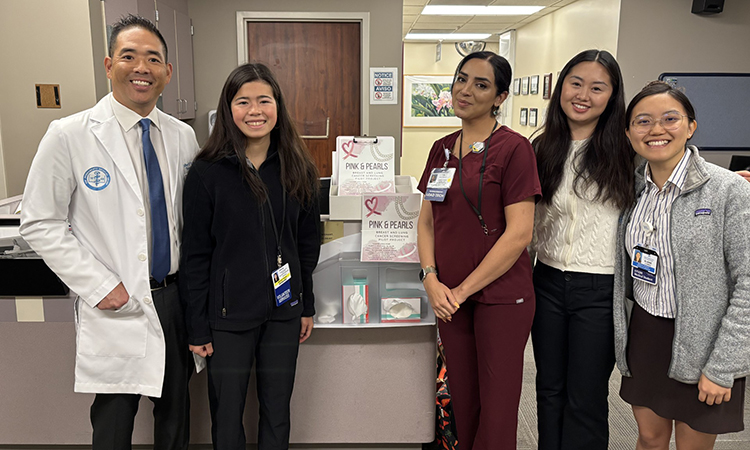
Dr. Jeffrey Velotta picks up smoking questionnaires at the Kaiser Permanente Oakland Mammogram Clinic along with high school student volunteer Marikit Flores; Maryam Soroush, Kaiser Permanente Radiologic Technologist Lead; student volunteer Lauren Leong; and KPSOM student researcher Elaine Liang.

Dr. Jeffrey Velotta picks up smoking questionnaires at the Kaiser Permanente Oakland Mammogram Clinic along with high school student volunteer Marikit Flores; Maryam Soroush, Kaiser Permanente Radiologic Technologist Lead; student volunteer Lauren Leong; and KPSOM student researcher Elaine Liang.

Kaiser Permanente Bernard J. Tyson School of Medicine (KPSOM) student Elaine Liang is first author of a study published in the Annals of Thoracic Surgery Short Reports examining whether mammography check-in could help identify women eligible for lung cancer screening. Jeffrey B. Velotta, MD, FACS, the study’s senior and corresponding author and KPSOM Clinical Professor of Clinical Science, teamed with Liang and fellow researchers to shed light on the importance of collecting a standardized smoking history, a potentially overlooked point of care. 

“What struck me most is that eligibility under USPSTF (U.S. Preventive Services Task Force) guidelines depends almost entirely on smoking history, yet we don’t capture it reliably,” said Liang. “Smoking history is dynamic: people start, stop, and change how much they smoke throughout their lives. If we can’t accurately calculate pack-years, many patients who already qualify for screening are being missed. I hope this study is a step toward closing that gap.” 

Liang added, “This was truly a team effort, from our high school volunteers who collected data on the ground to our Kaiser Permanente statisticians and surgery residents who shaped the analysis and ideas. I’m especially grateful to Dr. Velotta, whose mentorship and trust in me made this project possible.”
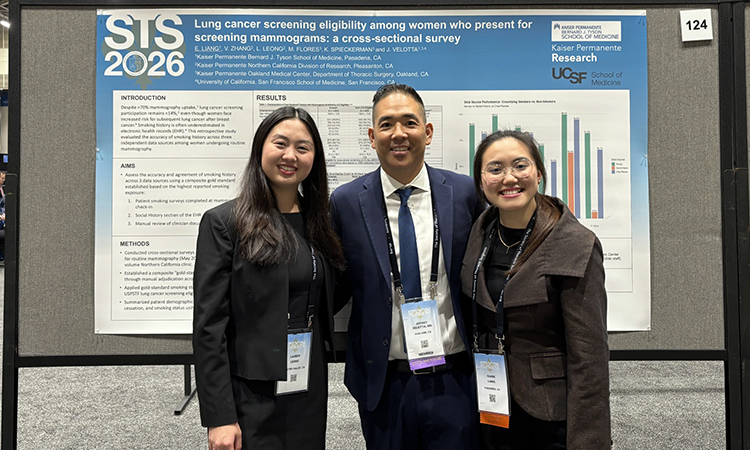

Student volunteer Lauren Leong, Dr. Jeffrey Velotta, and KPSOM student Elaine Liang present at the January 2026 Society of Thoracic Surgeons Annual Meeting in New Orleans.

Student volunteer Lauren Leong, Dr. Jeffrey Velotta, and KPSOM student Elaine Liang present at the January 2026 Society of Thoracic Surgeons Annual Meeting in New Orleans.

The researchers compared patient surveys with two sources of electronic health record (EHR) data among 1,299 women undergoing mammography screening at Kaiser Permanente Oakland Medical Center. The survey identified 19 patients who met U.S. Preventive Services Task Force criteria for lung cancer screening. Of these, 37 percent had no documented prior screening counseling or low-dose CT screening. General chart history, drawn from provider notes, aligned more closely with patient reports than the structured EHR social history section, which often lacked the detail needed to calculate lifetime smoking exposure. The findings suggest that patient-reported smoking surveys at routine visits such as mammography, paired with more complete and automated EHR processing, could help clinicians identify eligible patients earlier and reduce missed screening opportunities.

“It has been an absolute pleasure to mentor and guide Elaine through this fabulous work of hers,” said Velotta. “She singlehandedly led from start to finish and really showed great leadership and dedication overseeing our younger students. It was a really proud moment. In addition, this seminal work provides an opportunity for us as a health system to capitalize on the already increased frequency of screening mammography and to improve our lung cancer screening uptake simultaneously.”

According to Liang, these findings are critical because asking a few additional questions about smoking history for patients arriving for routine mammograms could reveal an unmet need for lung cancer screening. Mammography was chosen because the women it serves largely overlap in age with those eligible for lung cancer screening, and lung cancer remains the leading cause of cancer death among women. That information gives physicians a clearer basis for discussing eligibility, follow-up, and timely screening, and it demonstrates how clinical observation, workflow design, and health data quality all converge to address a practical gap in care. For health system leaders, the study points to mammography visits as an existing touchpoint to strengthen screening assessment, without requiring patients to schedule a separate visit.

The research team thanked KPSOM research staff and, in particular, Jonathan Finkelstein, MD, MPH, Senior Associate Dean for Research and Scholarship; Michael Gould, MD, MS, Faculty Director of Research and Professor of Health Systems Science; Alice R. Pressman, PhD, MS, Professor of Health Systems Science; and Farihah C. Rahman, MPH, Research Project Manager, for helping propel the research. 

Read the full study here .