Education and Training

Visiting Kenyan Medical Student Reflects on Six Weeks at KPSOM

Moi University's Sherlyn Kirui compares care in Kenya and the U.S. and describes what the two systems can learn from each other

October 01, 2026

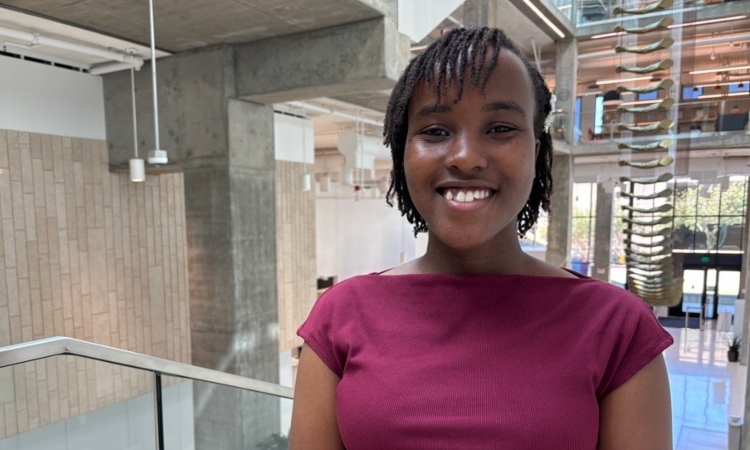
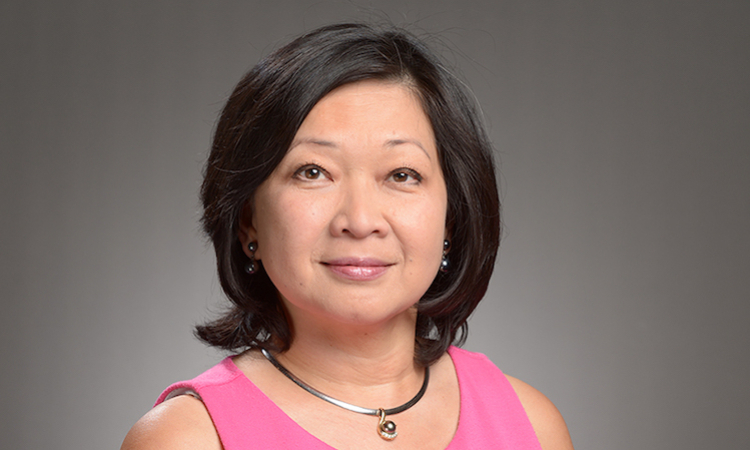
Sherlyn Kirui.

Sherlyn Kirui.

Sherlyn Kirui, a fifth-year medical student at Moi University in Eldoret, Kenya, recently finished a six-week clinical and educational rotation at Kaiser Permanente Bernard J. Tyson School of Medicine (KPSOM). She closed out her stay with a presentation on how working with advanced U.S. medical technology, preventive care models, and a collaborative culture of patient care at KPSOM and Kaiser Permanente medical centers had shaped her training.

Kirui gave her presentation on September 23 to faculty, staff, and KPSOM students. She walked the audience through her clinical rotations, compared the Kenyan and U.S. health systems, and shared what each one can learn from the other. Her time at KPSOM was part of the school's Global Health program, which collaborates with the AMPATH consortium to send KPSOM students on rotations abroad and bring medical students from partner institutions to Los Angeles.

"When we come to this program, it's not a matter of what the exchange students can only take from [KPSOM], but what we learn from each other," Kirui told the audience. "My major goal was to soak as much as possible in, and to just learn from this other different clinical setting and to interact with students to [understand] how medical school is here."

Before she arrived, Kirui said, "My expectations of the U.S. health system were majorly shaped by watching U.S. medical shows and hearing stories from other students who came here before us." She said she "expected to learn in a technologically advanced setting to see patients have access to very advanced diagnostic and therapeutic procedures and a very subspecialized and specialized healthcare system."

This summer marked the third year that KPSOM has hosted students from Moi University School of Medicine, said Jeffrey Brettler, MD, Faculty Director of Global Health. KPSOM does this rotation differently from many other host institutions, which usually keep a visiting student on one service for all six weeks, said Brettler.

"Our philosophical approach has been to do more of a portfolio of programs within Kaiser Permanente, so they get exposure to inpatient, outpatient, highly specialized tertiary care referral programs with a lot of emphasis on technology and cost, all the way to primary care, where they can learn about Kaiser Permanente's health system and our approach to population management," he said. "They may only rotate through a particular service for a day or two, but they come away with a much broader understanding of how care delivery is established here."

Much of Kirui's time was spent in cardiology. There she got hands-on practice with point-of-care ultrasound, which she said is not readily available in Kenya, and watched cardiac catheterizations. She noted that Moi Teaching and Referral Hospital, where she trains, opened its own cardiac catheterization laboratory only a year ago. "And seeing that patients can be able to access this type of procedure for life-saving interventions is really good," she said.

In neonatology, she saw a baby born at 22 weeks being cared for. "And in Kenya we say that 26 weeks or 28 weeks is the age of viability," she said. "And seeing a 22-week-old preemie being supported was a game changer."

She also rotated through anesthesia and surgery, where robotic surgery was a highlight, and through interventional radiology, which she has not yet studied at home. "I got to see diagnostic biopsies being done, minimally invasive procedures that are lifesaving, like angiograms," she said.
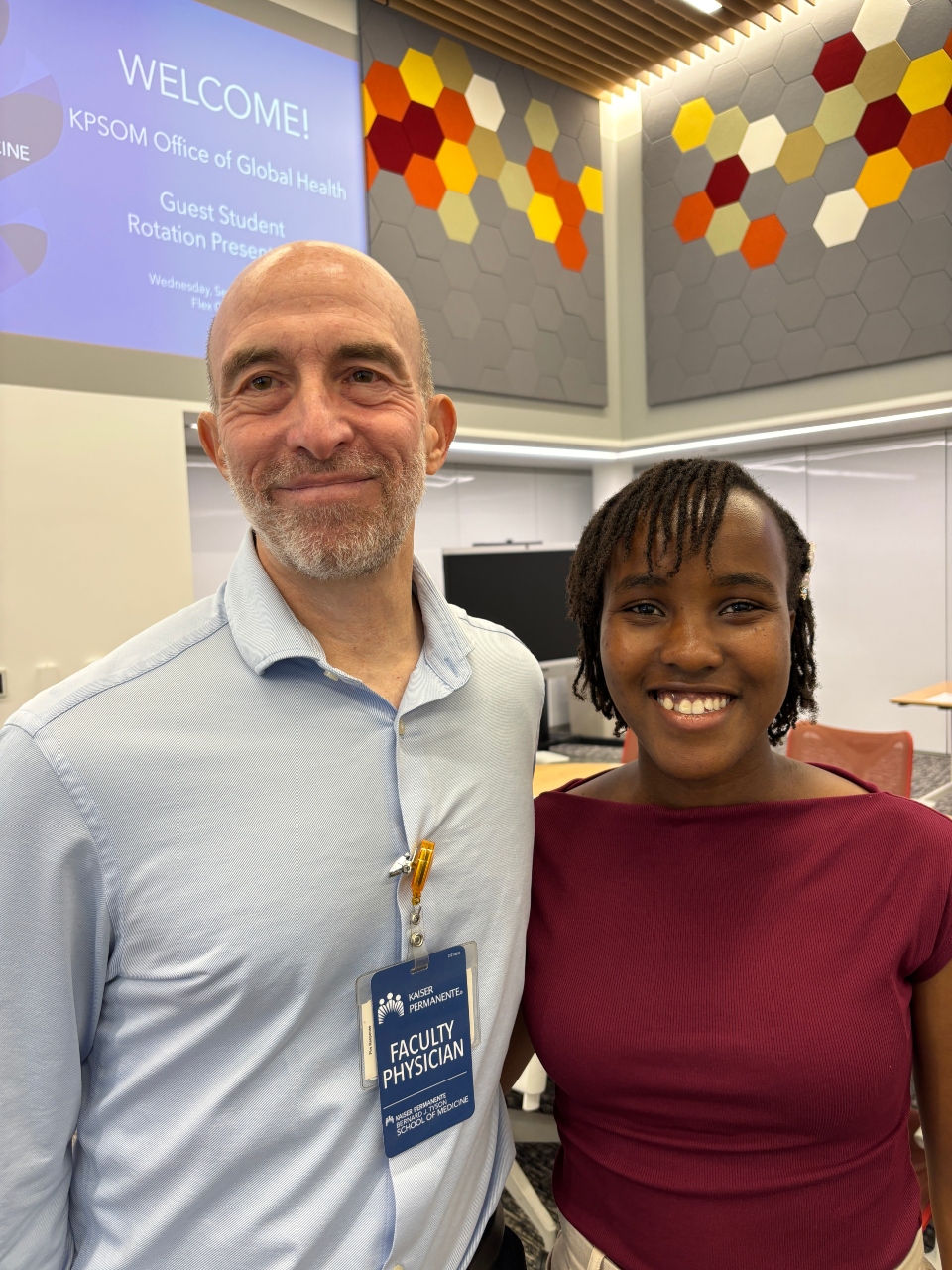
Dr. Jeffrey Brettler and Sherlyn Kirui.

Dr. Jeffrey Brettler and Sherlyn Kirui.

She described Kenya's system as largely centralized and government-led. Care moves from community-level facilities up to tertiary centers like Moi Teaching and Referral Hospital. Communication between specialties is fragmented, and patients put "100 percent of their trust on the physician." The U.S. system, as she observed it at Kaiser Permanente, is decentralized and mostly covered by private and employer-based insurance.

She was most struck by how involved patients are in their own care. Kaiser Permanente's integrated electronic health record, HealthConnect, lets clinicians see a patient's full history, and the patient portal lets patients check their own labs and procedures.

"I would see patients come with notebooks to the clinic and request labs," she said. "And I think that's a very major thing that contributes to preventive medicine here in the U.S."

Kirui said the lessons go both ways. Because electronic records in Kenya are still a work in progress, clinicians there depend heavily on taking a history and doing a physical exam, which she said "forms around 60 percent of the diagnosis" and builds a close relationship between clinician and patient. Working with limited resources, she said, has taught Kenyan physicians to adapt. "In my own opinion, the definition of a good doctor is one who is able to adapt to different clinical settings," she said. "You can have all the clinical knowledge, but if you're not able to provide the care that is appropriate in different clinical settings, then that becomes a problem."

She compared medical education at the two schools the same way. She praised the mentorship, research opportunities, simulation training, and advanced anatomy lab at KPSOM. At Moi, she said, learning is largely self-directed: "they say that the faculty or the physicians just give the students around 20 percent and you have to seek out the other 80 percent for yourself." Kenyan students are often asked how they would treat a patient without access to imaging or a CT scan. "That's a skill that is important to develop, even [as] a student in this high-resource setup in the U.S.," she said.

Kirui also noted the culture of open conversation among students, faculty, and attending physicians at KPSOM, contrasting it with the more hierarchical setting she is used to at home, where “students are afraid to engage with the attending, students are afraid to engage the faculty," she said. "Here, there's free interaction between students and the faculty, students and attending. And I think that has boosted my confidence as a medical student."

The KPSOM Department of Global Health runs its Kenya exchange with AMPATH (Academic Model Providing Access to Healthcare), a consortium of universities and health institutions working to strengthen health systems and reduce disparities. The exchange is reciprocal. KPSOM students go to Moi University in Eldoret for clinical electives, and Moi students come to KPSOM for rotations like Kirui's.

"One of the nice things about being part of the AMPATH Consortium, which we really believe in and agree with, is the reciprocity ... Everything we do should be bidirectional," Brettler said. "So, whether it's education, training, clinical collaboration, or research, [it] should be really a true partnership between the two different institutions. And this reciprocal program is a manifestation of that."

Kirui ended her presentation by thanking the AMPATH team, the KPSOM Global Health team, Kaiser Permanente physicians and faculty, student ambassadors, and her classmates in Kenya: "Asante Sana."