Match Day is one of the most anticipated milestones in a medical student’s journey, marking the moment when years of study, sacrifice, and service crystallize into a first role as a resident physician. On this day, graduating students across the country learn where they will continue their training, often surrounded by classmates, mentors, and loved ones who have cheered them on through late nights, daunting exams, and unforgettable patient encounters. At Kaiser Permanente Bernard J. Tyson School of Medicine (KPSOM), Match Day is not only a celebration of individual achievement, but also a reflection of the school’s mission to prepare future physicians committed to patient-centered care.
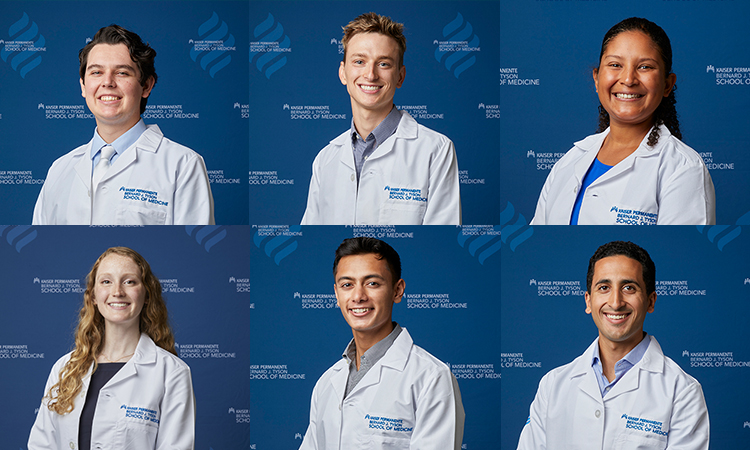
Match Day symbolizes both an ending and a beginning: the close of undergraduate medical education and the start of a new chapter in residency, with all the responsibility and possibility that entails. In the days leading up to this year’s celebration, six graduating students from the Class of 2026 reflected on the challenges they have overcome and the hopes they carry into the next phase of their training at programs across the nation.
The following interview excerpts have been lightly edited for length and clarity.
What life challenges make Match Day significant for you?
Dalja Parks: Match Day serves as the end of something that I truly wasn’t sure I would be able to do. As a first-generation student and a cancer survivor, I’ve spent as much time in hospital gowns as I have in [a] white coat, probably even more in the gown than the coat. Navigating a diagnosis while trying to pave this path was a massive hurdle. Seeing my name on that envelope isn't just a career milestone, it’s a victory over my own body and a testament to the fact that my experiences as a patient have prepared me to be a better advocate for those I’ll serve.
Andrew Ballester: Life doesn’t always go to plan. This is something I learned firsthand just trying to get into medical school. But I embraced the challenge, poured everything into my application, and ultimately got a shot at KPSOM. Now, as residency lies just beyond the horizon, the chance to discover my home for the next four years is no longer just a dream. And I aspire to continue riding the waves of life and embracing the challenges that lie ahead.
Blake Colton: Before my mom passed away in 2022, she walked across the stage with me as I received my first white coat [at White Coat ceremony]. Knowing that she won’t be here for Match Day is a reminder of all the future milestones she’ll miss. But it’s also a chance to remember and honor all the ways my mom has supported me along this path, and knowing that she’ll be with me wherever it is that envelope sends me. Every step of the way.
Barune Thapa: When I was sixteen, my dad suddenly passed away from a cardiac arrest. He was just 49. In that moment, I told myself I wanted to prevent that kind of pain and suffering for others. Losing my dad is what led me to medicine, and specifically the intersection of global health equity and cardiometabolic health. Match Day would have meant so much to my dad … That I now have a job as a doctor, that I get to care for people and work to prevent deaths like his, it would have meant the world to him. It is the greatest honor of my life to get to do that.
What does starting your residency mean to you?
Alexa Reilly: I get to really focus on the parts of medicine that I’m most passionate [about] and take charge in caring for my patients. I also get the opportunity to get really good at surgical skills and other hands-on skills. It also means that I did it! I finished med school and I get to be a doctor.
Barune Thapa: It means I finally get to be in the thick of it. I’ve spent over a decade building the foundation—public health training, fieldwork, research, clinical rotations—and residency is where all of that becomes materialized into caring for the patient. I’m excited to learn on the job, to be challenged every day, to really know how to care for patients with the most excellent care possible. There is so much I still need to learn, and I’m genuinely thrilled to learn it.
Dalja Parks: For a long time, I was the one receiving care and wondering about the “why” behind the medicine. Now, starting residency, I will finally be the one that will get to be the one providing the answers. This milestone is important because it’s the official start of my career.
Blake Colton: Residency is a job! With a paycheck! I have to say I’m excited about that part. This being our first job as a doctor marks a milestone along a career that, up until this point, has been a distant next step. It’s wild to think of the marathon that we’re finishing only to start a new one in a couple months. Still, the celebration of finally matching into residency is compounded by all the accomplishments and challenges of the journey that’s led us here.
Who has been most influential in your life to get to this moment?
Anthony Zamary: My dad has been the most influential in my life as I journeyed through medical school to this moment. He is a pulmonary and critical care physician who is incredibly dedicated and has been practicing for almost 40 years now, while also raising my siblings and me after our mother passed away. As part of a vibrant Coptic Christian diaspora community, I saw how helpful he was to our community as a physician, and I knew I wanted to do the same one day.
Alexa Reilly: My parents have always been supportive of me, including when I decided to start taking pre-med classes and get ready to apply for medical school after I’d graduated. My mother-in-law has also been very influential as I pursued this path. I didn’t have anyone in medicine in my family before meeting her, so she has always helped me see what it’s like to be a doctor and encouraged me along the way.
Dalja Parks: My parents and siblings without question. As a first-gen student, I didn't have a roadmap for medical school, but I had my parents’ work ethic. They didn't always understand the science of what I was studying, but they understood the sacrifice. They taught me that if you have the privilege to help someone, you do it. Their resilience during my illness and their unwavering belief in me are the reasons I’m standing here today.
Barune Thapa: Dr. Chileshe Nkonde Price was my small group facilitator … My REACH coach, Dr. Juliet Hwang has also been deeply influential … Dr. [Elizabeth] Duenas was my LIC FM preceptor in [first] and [second] year. She was the foundation for the way I practice medicine … And my father. He is not here, but he remains the most influential person in my life. His death gave me purpose. Every rotation, every publication, every flight to Kathmandu has been in service of the vision his loss created in me—to be a physician who cares for the whole patient, who understands why people get sick, and who fights to change the systems that make them sick in the first place.
How did you choose your specialty?
Dalja Parks: I chose Internal Medicine because I love the complexity of the whole person. After navigating my own health battles, I became fascinated by the heart, which [is] the literal engine of our survival. In cardiology, you see the intersection of acute, life-saving interventions and long-term chronic management. For me, it’s about getting to know patients and helping them through this moment of their life. I want to be the person who helps a patient keep their engine running so they can reach their own personal milestones, just like my doctors did for me.
Andrew Ballester: Medicine is also a job, and one that demands much physically and mentally. To succeed, you must be able to take the good with the bad. And that understanding was a key consideration as I explored specialties. I looked for something that brought me gratification in the not-so-illustrious moments. Something where I enjoyed the ebbs as much as the flows, and where the day-to-day realities of the job were also rewarding. Ultimately, anesthesiology was a field where I could see myself showing up to work with joy each day.
Barune Thapa: On my internal medicine rotation, it was just so obvious to me that I was genuinely having fun. I love spending time with patients, and internal medicine is a field that really lets you interface closely. The combination of advocacy, possibilities in global health, and systems thinking (organ systems and social systems) is what drew me to it. Being a good internist means understanding why your patient is sick, rather than just what medication to prescribe. That’s the kind of physician I want to be.
Blake Colton: When I would think abstractly about my career as a doctor, I imagined being able to help anyone who walks in the door, whether that’s through a conversation, medication, procedure, or referral. Family medicine lets me do that and more. Deciding to pursue it as my specialty allows me to open doors for my future while keeping me excited about the work I’ll be doing until I get there.
Alexa Reilly: I chose ob-gyn! Going into medical school, I was interested in this field because of personal experiences I’d had as a patient. I wanted to advocate for patients like me. When I did the rotation in medical school, I fell even more in love with the specialty. Ob-gyns get to support patients going through the hardest times of their lives and, sometimes, the happiest times of their lives. Ob-gyns also get to use hands-on skills by doing surgery, delivering babies, and doing a wide variety of in-office procedures.
What factors helped you decide which residency programs to apply to?
Blake Colton: My non-negotiable for a residency program was that they had robust and comprehensive training in sexual and reproductive health, including abortion care, HIV treatment, gynecological procedures, and gender-affirming care. I also wanted to ensure that residency would make my life bigger, that I would expand my personal life alongside the professional.
Alexa Reilly: The main factors I considered were location, academic vs. community, and culture. Location near family was a big factor for me! One consideration … was family planning. If my husband and I decide to have a baby in residency, we will want to be near family, and I’ll want to be in a residency program where residents feel supported when they have family obligations. In general, having a supportive, close-knit culture was very important to me.
Andrew Ballester: Three things: career goals, location, and personal fit. The first was relatively easy. I researched each program’s fellowship placements, alumni network locations, and contributions to the field overall. If they aligned with how I envisioned my career in 10 to 20 years, I more strongly considered applying there. For location, I knew I wanted to be close to family and friends, and in a big city with ample Spanish-speaking populations.
Barune Thapa: Location, clinically excellent training, and strong global health mentorship with social medicine thinking built into the residency. My partner is a resident in Boston, so being in the same city was a real priority for me. Medicine is hard, and I wanted to go through it with the people I love nearby. Clinically, I wanted to be challenged … And I wanted a program that really values and upholds social justice as a key principle and shows it through where they put their money, their faculty, and their mentorship.
Dalja Parks: I looked for three main things ... The clinical rigor, a commitment to health equity, and a family culture. I applied to programs that don't just treat the disease but also look at the patient’s zip code. I also prioritized programs with strong cardiology fellowships, but most importantly, I looked for residents who seemed genuinely happy and supported by their leadership.
What medical school experiences did you discuss most in your residency interviews?
Alexa Reilly: I discussed my global health rotation in Tijuana, Mexico a lot. This was a rotation that I helped create along with the global health department and a classmate, so I was really proud that the course will continue being offered to students and I had an amazing experience to talk about! I also discussed my scholarly project on fine particulate matter (air pollution) and spontaneous preterm birth, as well as the unique structure of the longitudinal integrated curriculum.
Dalja Parks: I talked most about the Service-Learning curriculum and the KPSOM micro-grant. I was incredibly proud of starting the community garden and food distribution program. It was a perfect talking point because it showed I’m a doer. I explained how we didn't just talk about food as medicine in a classroom; we actually put shovels in the ground to address food insecurity in our local community.
Barune Thapa: I discussed my research: my first-author paper in diabetes care on diabetes remission across six Kaiser Permanente health systems, and my cardiac rehabilitation research with Dr. Chileshe Nkonde Price examining how neighborhood disadvantage affects outcomes for heart attack patients, now published in JAHA. I also frequently talked about work I did before medical school: my research on historical redlining and COVID-19 disparities, and my Sheldon Fellowship in Nepal, where I studied how economic forces shaped a village’s experience of the pandemic.
Andrew Ballester: The most popular were my scholarly project (or other research projects interviewers found interesting), my HSS patient safety elective, and my core second-year rotations. As many program directors are still somewhat unfamiliar with the LIC model, I often found myself discussing the unique elements of this learning experience.
Anthony Zamary: My time on the student curricular board came up a fair amount. Programs seemed genuinely interested to learn more about our unique curriculum and innovative, service-oriented medical school. My Service-Learning practicum also came up several times, as the project was related to the specialty I pursued.
Blake Colton: Nearly every residency program that I interviewed with brought up my Service-Learning practicum project. The more I spoke about it, the more meaningful it became to me. When I was doing the project, it was hard to see the impact it would have on the community and on my education, but the reflection really brought out a new layer of gratitude for the opportunity to work with our community partners.
What is most memorable about KPSOM’s Class of 2026?
Blake Colton: At the start of med school, we were still wearing masks and attempting to social distance, which feels like a bit of a time capsule when looking back on the start of our journey.
Barune Thapa: We were a loud class. A class of advocates—for ourselves and for others. At times that advocacy was not always received the best. But it also made us resilient. We showed up for each other, and we pushed for things to be better. Despite all of that, I’m proud to see us all get to this point. Fourth year was genuinely great; finally having the time and space to pursue my passions, to travel, to do the work I came to medical school for. And I think our class carries a kind of scrappy determination that I’m proud of. We are a product of what we went through, and I think that will make us better physicians.
Alexa Reilly: The class of 2026 students are very caring and not afraid to speak up to help each other or to advocate for our patients.
Andrew Ballester: What I will always remember my classmates for is their ability and willingness to advocate for themselves. When something could be improved, we worked to ensure our voices were heard. After all, many of us chose to come to a new medical school with the vision of improving medical education for other future doctors. Though we come from different backgrounds and lived experiences, we always saw ourselves as one unit that could use our power in numbers to advocate for change.
What will you miss about KPSOM?
Alexa Reilly: I’ll miss my classmates! They're some of the coolest people I know. I’ll miss the mentors I’ve met here. I’ll also miss Pasadena and its year-round sunshine.
Anthony Zamary: I will, of course, miss the supportive and kind community at KPSOM, especially the staff, faculty, preceptors, and students. I will also really miss our medical education building and the city of Pasadena. I feel very blessed to have studied medicine in such a beautiful city and to always have found a peaceful place to focus on campus (with free coffee)!
Andrew Ballester: KPSOM is filled to the brim with high-quality individuals in every facet. Each staff member, faculty mentor, and student brought something unique to the table that made KPSOM a special place to learn. The chance to grow here is one that I am incredibly grateful for. Though medical school is filled with endless challenges, I could always remind myself just how blessed I was to be able to attend KPSOM.
Dalja Parks: The sense of belonging and of course the friends I met along the way. I’m going to miss walking down the hall and being able to chat with classmates and other medical students. Most of all, I’ll miss the daily inspiration of my classmates. Being surrounded by people who are all equally passionate about social justice and medicine made the hard days a lot easier. My class is funny and I will miss being able to laugh with them.
Blake Colton: I’ve met lifelong friends at KPSOM, and although I won’t miss the trenches of med school, I will miss the people I had alongside me.
Barune Thapa: The people. My friends, my REACH coach Dr. Hwang, Dr. Price, Dr. Duenas, my other LIC preceptors and my sub-intern attendings too. These people really invested in me. They believed in me when I didn’t always believe in myself. They taught me, guided me, showed me the way. I will miss them.