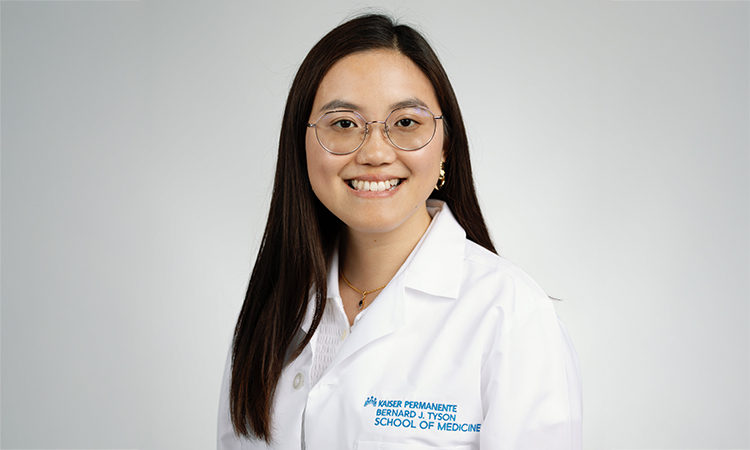
Kaiser Permanente Bernard J. Tyson School of Medicine (KPSOM) student Elaine Liang served as conference host of the 2025 International Journal of Medical Students (IJMS) World Conference of Medical Student Research (WCMSR), which took place Nov. 15 through 16. The fourth-annual, medical-student run virtual conference brought together medical students and residents from around the world, including those from regions where there are limited opportunities for global research engagement, such as Palestine, Ukraine, and Nepal.
Liang learned she was selected to serve as the conference’s Master of Ceremonies in June 2025 after applying for consideration following her year-long stint as an IJMS Student Editor. Since, she has developed Instagram promotional videos for the conference and contributed two editorials, including Uniting for Peace Through Science: A Call to Action from the IJMS and the 4th WCMSR and Blueprints for Discovery: The Anatomy of a Global Medical Student Research Conference .
Her responsibilities as the Master of Ceremonies included managing judge and panelist discussions, announcing conference awards and recipients, and helping to ensure the pace and timeliness of the virtual conference. Liang worked closely with a team of international medical students from countries like Australia who managed the technical aspects of the virtual conference, which allowed her to help manage technical difficulties firsthand in an environment where thinking on one’s feet and adapting quickly was key.
The conference was held virtually to maximize accessibility and allow medical students worldwide to participate without the financial burden often associated with traveling to in-person conferences. Launched in 2022 during the COVID-19 pandemic, the conference has consistently drawn thousands of attendees from around the globe. Not only did this year mark the fourth iteration of the conference, but also the first time a second day was added specifically for poster presentations, expanding opportunities for students to share their work. This year’s conference theme was “Uniting for Peace Through Science: A Call to Action” and current medical students and residents who graduated from medical school within the past two years were eligible to submit research to the conference.
“I realized how powerful the conference was when I looked at the final participant list and realized that these students were coming from countries in parts of the world in which there really aren’t that many opportunities for them to share their medical research,” said Liang. “In fact, it's actually very difficult to do medical research in areas of the world that they're in, especially as a medical student or even [someone] freshly out of medical school as a resident.”
Liang further noted that some conference participants live in countries experiencing significant socio-political turmoil, which adds pressure and stress to students and residents striving to maintain their clinical duties and research pursuits. Participants discussed the medical systems of their respective countries, and Liang learned that many places offer little to no incentive for trainees to engage in research, an insight that broadened her perspective. These conversations gave this year’s conference theme—using medical science as a unifying force for peace that transcends borders and nationalities—an even deeper and more resonant meaning. This year’s participants were honored to take part in the conference, Liang said, and appreciated the quality, actionable feedback they received from volunteer conference judges on their research.
“I think that really helped the participants elevate [and] realize that there is an international community there to help them on their research, especially given how difficult it is to pursue medical research on top of their already stressful medical and clinical duties as students and residents,” said Liang. She added that it was inspiring to see students worldwide convene to talk about their research interests in relationship to their culture, particularly those who explored topics only seen in their respective parts of the world such as endemic diseases and more.
The conference provided participants an international platform to showcase impactful work and disseminate research to a supportive international community of medical students, residents, and judges who are medical doctors. Liang said the conference reinforced that breaking barriers in research is not just for the most developed countries but instead can be achieved by anyone within the international research community.
“It's not an ivory tower. Anybody can do research, regardless of [whether] you're a medical student in the United States or a medical student in Nepal or Bangladesh,” said Liang. “You can do good research and there is an international platform for that. We're trying to inspire the next generation of international medical students and residents, especially those in developing countries, towards research and to realize that you can do research wherever you are, regardless. I think the main goal is to make research accessible, especially early on in their medical careers.”
Liang, who currently serves as a student editor of IJMS, a peer-reviewed, international medical student-run scientific journal dedicated to sharing the scientific production of medical students worldwide, said next year’s conference will be held July 11-12, 2026. She encourages medical students who are applying for residency and new job opportunities to keep the IJMS World Conference of Medical Student Research in mind, especially considering its strong focus on accessibility to research within an international research community and health equity.
“[Being a part of this conference] was very meaningful to me and … it makes me so grateful that I have the research opportunities that I have, and it is a chance for me to give back and provide a similar opportunity for medical students worldwide to participate in a research conference, too,” said Liang.