For patients undergoing surgery to repair a broken wrist, a regional nerve block can offer meaningful benefits: less opioid use, lower pain scores, less nausea and vomiting, and a shorter recovery. But new research also points to a challenge after patients go home, with an increased likelihood of seeking emergency care for pain during the first week after surgery.
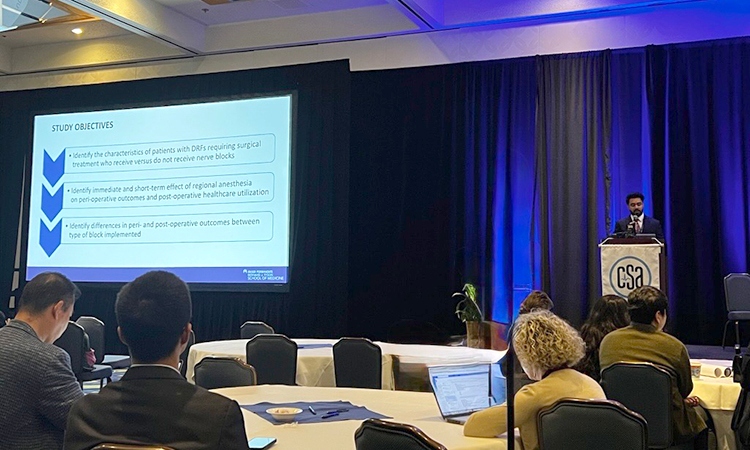
The findings come from a multicenter retrospective cohort study coauthored by Kavenpreet S. Bal, a student at Kaiser Permanente Bernard J. Tyson School of Medicine (KPSOM). Published in the peer-reviewed journal Regional Anesthesia & Pain Medicine, the study examined 5,635 adults who underwent surgical repair of a distal radius fracture (a break near the wrist) in Kaiser Permanente’s Northern California service area between 2017 and 2022.
About two-thirds of the patients studied received a brachial plexus block, a form of regional anesthesia that numbs the arm. The remaining patients received other combinations of sedation and pain medication. In addition to better immediate pain control and recovery measures, the nerve-block group had a pain-related emergency department visit rate of 1.6 percent within seven days, compared with 0.5 percent among patients who did not receive a block.
Distal radius fractures are among the most common fractures in adults. During surgery, anesthesiologists may use general anesthesia with opioid pain medication or combine sedation with a regional block. The new findings do not suggest that clinicians should abandon nerve blocks, but they add evidence that the choice of anesthesia has implications extending beyond the operating room and recovery unit. The findings give clinicians a practical question to investigate: how to preserve the benefits of regional anesthesia while helping patients anticipate and manage pain once the block subsides.
For Bal, the project offered a chance to examine decisions he had encountered during anesthesiology rotations. “Those decisions are something that I had a hard time figuring out when I did my anesthesia rotations,” he said. “This research really let me understand what that process and what that evidence looks like behind a lot of these decisions.”
Bal joined the research team through Edward Yap, MD, an anesthesiologist with The Permanente Medical Group, adjunct investigator with the Kaiser Permanente Division of Research, and lead author of the study. Data collection and some statistical work were already complete when Bal came aboard. He helped create graphs and figures, contributed to analyses, and took a leading role in writing the manuscript.
The scale of the data was central to the experience. “By having such a large set of patients that we’re able to follow across different medical centers in California, we’re really able to have one of the largest sample sizes to really be able to evaluate clinical questions,” Bal said. He noted that retrospective studies can use existing clinical information to examine real-world outcomes when a clinical trial would require more time and expense.
The increased rate of pain-related emergency visits was the result that stood out most to Bal. The researchers suspect that some patients may experience a sudden escalation in pain when a long-lasting nerve block wears off. Although the absolute rates of emergency visits were low, the difference suggests an opportunity to improve how patients are prepared for that transition.
“I think [it] suggests the most important thing to do is to really counsel patients that they will likely have a recurrence of pain after [the anesthetic] wears off, and to guide them through what that looks like, and when to consider going back to the emergency room versus when they may not need to,” Bal said.